| Newsletter Autumn 2008 | page 4 of 5 | |
 |
|
|

Bee story:
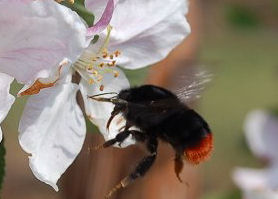 The Irish honeybee has been suffering badly for the last few years, because of a tiny parasite called Varroa. No bigger than a pinhead, this little mite sucks blood from the bees, making them weak. To make matters worse, it now appears that the mite also transmits viruses, and that these can lead to the complete collapse of honeybee colonies. In a way this story has parallels with the potato famine story. At that time all the farmers relied on a single variety of potato called the lumper, and when blight arrived it raced through the crops, because there was no genetic diversity in the potato crop that would make it more difficult for the blight to get a foothold.
And so we now arrive in a place where all the “cultivated” honeybees of the World, (and many of the wild colonies) can be traced back to the Italian strain, and like the Irish potatoes, they are all genetically similar. But the parasites and viruses come from every continent, and are able to overwhelm the bees with ease. And once again nature is teaching mankind of the importance of diversity to survival of the species.
It is estimated that 80% of crop species produced in Europe are insect pollinated, and some will fail to give any crop unless visited by bees or other insects. Luckily, the honey bee is not the only bee that visits flowers in Ireland. In fact there are 20 different species of native bumblebees in Ireland, as well as numerous other bee species. We share one particular sub-species of bumblebee, called Bombus terrestris audax with the UK. This is a hardy sub-species of the bumblebee found throughout Europe, but it has adapted to our climate by living in very small colonies, and foraging at very low temperatures. In fact, native Irish bumblebees of this species can be seen in fine weather during any month of the year.
However, this species could also be under threat, not because of a parasite, but because of the importation of bumblebees from warmer parts of continental Europe. These bumblebees are similar enough that they can cross-breed with the native Irish bee, but different enough that their offspring no longer keep their survival habits such as living in very small colonies. This process of genetic homogenization or mixing has the potential to wipe out our native bumble bees, with serious consequences for plant, man and society. Guidelines have recently been issued to people who import bumblebees, instructing handlers on how to prevent cross-breeding with native populations. Hopefully they will prove successful, before we learn another lesson on the importance of genetic diversity.
- Page 1: News from The Apple Farm
- Page 2: Irish American apples
- Page 3: Walking on Sliabh na mBan
- Page 5: Slow Food
- Newsletter main page